


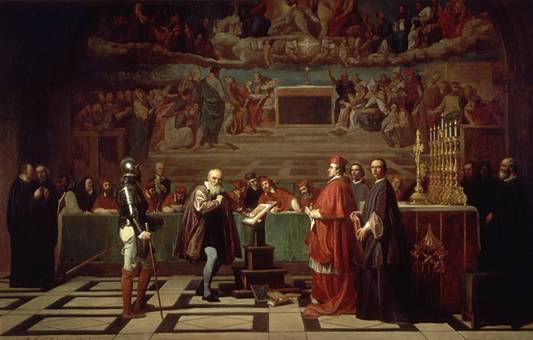
A 19th century depiction of Galileo before the Holy Office, by Joseph-Nicolas Robert-Fleury (Wikicommons)
When the Board of Trustees at Shorter College in Rome, Georgia lost a long legal battle with an increasingly fundamentalist Georgia Baptist Convention, many of us held out hope that the faculty, students, and alumni would be able to fight back against the pernicious influence of fundamentalism. Our vigil is finally over. Shorter (now “Shorter University”) has drawn its last breath as a legitimate institution of higher learning. On October 25, 2011, Shorter’s Board of Trustees adopted a collection of documents which, according to university president Dr. Don Dowless, are to serve as a “continuing affirmation of our Christ-centered mission.”
On the surface, that sounds like a fantastic idea. A university centered on the teachings of Jesus would be an exciting place to study. Imagine a learning environment where students are taught to question everything they had ever learned, and to never settle for pat, easy answers [John 8:1-11]. Think of a school where students are taught to reject the materialism and acquisitiveness of modern society [Luke 3:11] and give all of their possessions to the poor [Matt 19:21]. An education centered on the teachings of Jesus would constantly challenge both conventional wisdom [Luke 6:20-26] and religious traditions [Matt 5:38-39]. It would certainly reject religious fundamentalism, just as Jesus did [Matt 12:1-12; Mark 2:27; 7:19]. Studying in such a place would mean joining into that beloved community of Jesus’ disciples who shared all their possessions with each other [Acts 2:44-47] and who shared constant fellowship in a setting that was free of prejudices of sex, social standing, or ethnicity [Galatians 3:28].
Unfortunately, the documents created by Shorter’s Board address none of these core biblical, Christian concepts. Instead, they talk ambiguously about “truth” and “biblical faith” and a “biblical worldview.” A little more digging reveals what they mean by these vaguely positive terms. The “Statement of Faith,” for instance, asserts that the institution takes the contradictory Babylonian creation mythology in Genesis as a literal, “historical account.” It even claims that there were two historical people named “Adam and Eve, from whom all human beings have come.” For Shorter, then, being a “Christ-centered” university means rejecting the major academic disciplines of History, Geology, and Biology. In addition, it means rejecting the well-established biblical scholarship that helps to preserve the value of these texts without requiring adherents to attain the cognitive dissonance necessary to take them literally.
The document goes on to outline other fundamentalist boundaries on the school’s theology, most of which would only matter to Religion scholars. Where the consequences of this meticulously worded theology become worrisome, though, is in the “Biblical Principles on the Integration of Faith and Learning.” That document states (and underlines) that “University staff will submit an annual plan with the letter of agreement that details how they will integrate the Christian faith into their specific areas of work.” Viewed in light of the preceding document’s definition of what the “Christian faith” is, every professor at Shorter – not just their Religion faculty – is now expected to conform their curriculum to Shorter’s incredibly narrow, and intentionally academically ignorant, characterization of what “Christian” and “biblical” belief entails.
This “Christianity” of Shorter University has little to do with the historic faith of the Church. Instead, it is a reactionary rejection of the past two hundred years of human evolution: progress that has given us ethnic and gender equality; progress that has freed us from ignorance about our past; and, progress that has saved us from superstition when we study the world around us. Since the Enlightenment, scholarship and study have toppled the authority of those who wish to indulge in prejudice and ignorance to advance their social and political agendas.
Consequently, fundamentalist groups like those now in charge at Shorter exist primarily to help those on the losing end of the Enlightenment reclaim the anachronistic superstitions that make their worldview possible. Fundamentalists camouflage their rhetoric in comforting terms like “Christian” and “biblical” in the hope that no one will have the theological or biblical literacy to recognize the hypocrisy and deception inherent in their approach. As a result, the greatest threat to their methods is an educated, literate populace – and so fundamentalists move their culture war to public school systems and, whenever possible, to institutions of higher learning. Shorter’s new policies make this agenda abundantly clear. Academic freedom at Shorter is now subject to an obscure and willfully obdurate understanding of “biblical truth.”
But the tragedy does not end there. The most bizarre and offensive of all these documents is the “Personal Lifestyle Statement” which all Shorter faculty must now sign. The document speaks of being “Bible believing Christians” and maintaining a “Christ-centered institution,” yet it makes no mention of pacifism, giving to the poor, rejecting religious fundamentalism, or any of the teachings of Jesus enumerated above and in the New Testament. In fact, being a “Christ-centered” professor at Shorter means having only four concerns: 1. Loyalty to Shorter and the Georgia Baptist Convention, 2. Drugs, 3. Sex, 4. Alcohol. Interestingly, the alcohol section is by far the longest and most detailed. Apparently Georgia Baptist fundamentalists are still fighting the Prohibition battles of the last century. That is particularly ironic since the Christ on whom the school claims to be “centered” famously made wine at a wedding [John 2:1-11] and was called a “drunkard” by his critics because, unlike John the Baptist, he drank alcohol [Luke 3:33-34].
Hypocrisy concerning alcohol aside, the statement on sexuality in section 3 is perhaps Shorter’s most tragic. That section equates premarital sex, adultery, and homosexuality – actively attacking the trend towards increasing inclusion of lesbian, gay, bisexual and transgender Christians in the larger Christian Church. As most of Christianity, and most of Western society, moves forward in rejecting anti-LGBT bias, Shorter University has chosen to plant its Crusader’s shield on the hill of bigotry and intolerance. As with all organizations that side with prejudice and ignorance, the judgment of history will record Shorter’s shame.
Shorter University has chosen to ally itself with those who want to draw a curtain of medieval shadow over the light of reason, learning and inclusiveness that sustains the work of a modern university. In so doing, they have consigned themselves to the ignorant backwaters of self-perpetuating fundamentalist scholarship, and they will eventually disappear into irrelevance – as happens with all institutions that uproot education and then plant indoctrination in its stead. By its own decision, Shorter University no longer matters in the modern world.
So then why should we care? What happens at Shorter matters for several reasons. First and foremost, the takeover and transformation of Shorter University should remind us all that education is a fragile thing. Many of the world’s evils are shielded by ignorance, and if we do not work actively to protect rigorous, open, free research and study we will lose them to forces eager to destroy them.
Secondly, it matters because we cannot allow people to easily ignore or dismiss what has happened to Shorter under the heading of “Well, that’s just what they believe. They should be allowed to teach what they believe.” Belief, like every other aspect of human experience, must be held accountable for its consequences and conclusions. Hiding ignorance and prejudice behind language of “faith” and “the Bible” cannot be tolerated. Slaveholders and abusive husbands did the same for centuries, and we can never return to a world where religious rhetoric becomes a sacrosanct excuse for oppression and bigotry.
Finally, what has happened at Shorter matters because, if it becomes the norm in Christianity, it foretells the death of the tradition. The Board of Trustees at Shorter College has chosen to define Christianity and biblical fidelity in terms of a small set of narrowly-constructed political issues. Apparently, for them being a Christian means: rejecting Biology, Geology, and History; oppressing LGBT persons; limiting academic freedom to narrow constructions of “truth” based on 3,000-year-old superstitions; and not consuming alcohol. If that is what Christianity becomes, it will be meaningless and dead within a century.
Standing against the forces of fundamentalism at Shorter University and elsewhere is not simply about fighting back against a far-right and reactionary political agenda. It is about preserving the ideals of post-Enlightenment education, holding religious beliefs accountable to the same standards of logic and cognitive health as any idea, and it is about preserving the expansive breadth of Christianity in a way that allows it to be continuously relevant to future generations. Shorter University has made it clear that the school stands directly in opposition to all of these things. The task remains for the rest of us to continue to move the world forward into a place where scholarship and faith instead work together to overcome superstition and injustice.
The Rev. C. Joshua Villines taught a wide range of courses – including Hebrew Bible, New Testament, Christian Theology, Church History, and Critical Thinking – as an adjunct from 2006 to 2008 in the Professional Studies Program at the former Shorter College. He now teaches as an adjunct in the College of Continuing and Professional Studies at Mercer University.

Bravo, Rev. Villines! Would you consider submitting this article to the Rome News-Tribune and other media? There are so many of us who support your views!
Kathy, I’m happy to submit it anywhere you suggest. Thank you for your kind comments and for taking the time to read it.
I have posted this on multiple Facebook group pages. Everyone is raving about how good it is and how this word needs to get out. You can send this to R N-T and I feel sure they will print it.
Thank you for writing this in such a common sense way. I graduated Shorter in 1978 in music and again in 2007 with a master of arts in leadership after teaching theatre there from 2003 to 2007. I breaks my heart that this once great institution now is led by such a narrow minded group. All the fine teachers that I learned from and work as colleagues with will probably leave “The Hill” and a once great institution with a great history will crumple to dust. It is truly sad.
Joshua – This is incredible. Please consider sending it to the Rome News-Tribune as a “guest article” or a “guest editorial” or a “letter to the editor”. It is a fabulous piece of work and EVERYONE needs to read it. Thank you so very much.
Editorial Department
Phone Number: 706-290-5252 Fax Number: 706-234-6478
Mike Colombo Editor MColombo@rn-t.com
Rome News-Tribune
305 East Sixth Avenue
PO Box 1633
Rome, GA 30161
Wonderfully written! Thank you so much for this thougtful article. Please consider sending it to the Rome and Atlanta newspapers.
Susan Nicely
Shorter College
Class of 1978
WOW…Thank you so much for the time, energy, effort, and care you have put into addressing the issues plaguing Shorter University. I taught there for 4 years and have maintained wonderful friendships with students, faculty, and staff. What is happening there is horrific and I really appreciate your insight.
Well-stated. I’m a United Methodist minister (retired) serving at Douglas Street UMC in Cartersville, where my wife is pastor. I am truly saddened to see Shorter fall into the camp of those who cast their intelligence and learning aside as a prerequisite of faith. We live near Barnsley Gardens, and my wife and her brother are Berry graduates, as is our daughter. I appreciate your willingness to state what is obvious to all those Christians who value education: that the sway of fundamentalism quickly robs us of real knowledge of God and substitutes the planting of firm absolutes of ignorance within our minds.
It’s a nice, well-thought-out article that, by missing the point, is mostly irrelevant.
The Southern Baptist Convention (which is the parent organization of the Georgia Baptist Convention and is the organization that really matters here) doesn’t care about anything that you have to say here. You’re arguing with them on the merits of their beliefs and actions. But all that is just window dressing to them, because what they’re solely after is power and control. These policies and faith statements, they don’t really care about them except as a way to get the people they don’t want out and to keep everyone else in line. This provides the background: http://www.sbctakeover.com/
Attacking the school or anything that’s going on there is just playing into their shell game. There is only one hope here, which is that what is happening to Shorter will start to awaken the regular Baptist membership up to agendas of the sociopaths that have taken over their leadership, and to take back the SBC.
I’d just like to add my encouragement for you to submit this inspiring piece to the Rome/Atlanta news outlets. It sums up what so many of us have been thinking in a much more cogent way than we could have done ourselves. I’m glad you have moved on to the more tolerant pastures of Mercer. If only Shorter had been as successful in breaking their bonds with the GBC …
Miriam Timmerman — Shorter College ’90
Thanks for this well-written piece that addresses the issue so clearly. I am a 1975 Shorter graduate and am teaching at the University at Buffalo in Social Work. I am happy to hear what you had to say about social justice, something close to my heart.
There is so much I could praise in this–well done. I look forward to reading it in the RN-T, and I’d certainly submit it to the AJC, and elsewhere. As a Shorter grad (1980) I’m aware that Shorter’s reputation (that of its Trustees, to be more exact) has been slaughtered and mocked on a national level. I would love to see this essay bring reason and clarity to those caught in the rip tide. Especially those who mistake the fleeting faces of those who have taken over, to be the true faces of Shorter. This essay brilliantly exhibits the best of what Shorter was, and hopefully will be again.What’s not of God, will not prosper. What’s hate-filled and fear-driven will not succeed. Thanks for keeping the true spirit of Shorter alive, eloquent, and fruit-bearing.
Bravo! I am forwarding your thoughtful, intelligently written essay to my south Georgia relatives with whom I grew up and who think my Episcopal beliefs are not always “biblical”. I hope your words will open their minds a tiny crack to allow enlightenment to seep in.
With the erosion of outstanding faculty, staff, and students, we will watch in sadness as Shorter U. becomes just another bible school sending young people into the world unprepared and unaware of the true meaning of the teachings of Jesus. Jeanne Cahill
Joshua,
I shared this article on my Facebook group page, Shorter College/University alumni discussion group. Since the Shorter alumni page is now being censored, not allowing any group members to post. I started my group last fall to let people have a place to post and connect about Shorter without being censored. My dad, Tom Lagow, taught history and political science at Shorter from 1961-2006 and served as chair of the History Dept. for many years.
Thank you for such a well written and thoughtful piece. I hope the members of the Board of Trustees read it!
Good article overall. I’m trying to be a bit more optimistic than some of your sweeping overstatements (such as: “For Shorter, then, being a “Christ-centered” university means rejecting the major academic disciplines of History, Geology, and Biology.”) I know the hyperbole makes for a better piece, but I’m trying to hope that Shorter will not fall quite so far. THough I could be wrong 😉
Greg – I wish I were being hyperbolic, but that is definitely not my intention. In fact, if anything, I understate just how pathetically anti-intellectual the new academic framework at Shorter is. You may want to look at my earlier piece, which addresses the changes at Shorter in more detail.
Shorter has already fallen.
I am a Professor Emeritus from the School of Visual Arts and Dance at Florida St. University, I wish to praise Rev. C. Joshua Villines for his magnificent observations and very clear writing gifts for identifying and presenting what has happened at Shorter College. Myself, a 70 year old, gay man, served the community of higher education with joy and love for my work for 30 years and after retirement from FSU, I served as a member of the professional ballet program’s faculty of Canada’s National Ballet School. I cannot imagine nor can I believe that this once small promising and enlightened school known as Shorter College, has now entered the “unhallowed halls” of darkness, claiming to identify itself as a university. Shame, shame on the school’s Board of Trustees for it’s obvious inability and lack of critical thinking as educators, for returning education and it’s gift of enlightenment for that matter, to the dark ages of the 11th century. Richard J. Sias
Certainly, they will be teaching anthropology. How else will students learn what type of dinosaur Jesus rode to work?
Thank you so much for the time you took writing this down. It’s so very readable, articulate, sound and enlightening.
THANK YOU FOR THIS MAGNIFICENT STRING OF WORDS MY PARENTS AND MARYVILLE COLLEGE ARE RESPONSIBLE FOR MY UNDERSTANDING SUCH ERUDITION THIS WILL ENCOURAGE OTHERS I BELIEVE AGAIN THANK YOU
Thank you. You so eloquently verbalize for us alumni what we deeply feel.
Shorter College 1978